Information can be regarded as facts obtained about a person, organisation, or government. Information is vital in every society because it enables development and creates an environment for solutions.
In Nigeria, we are often quick to spread information that hasn’t been verified, this causes major unsettlement. Efforts have been made by individuals and organisations to ensure information is checked effectively.
While the 2023 elections are fast approaching, there have been several calls for people to guard themselves against fake news. We are witnesses to several false claims being churned out already by politicians and the likes of Africa Check, Dubawa, Roundcheck, The Cable and other news mediums have been doing excellently fact checking and debunking claims.
However, the fact that these false claims keep emanating places the responsibility on everyone to be responsible for whatever information they put out there and whatever information they consume.
The coalition of Fact checkers during a conference earlier in September appealed to politicians to stop spreading disinformation, perhaps the false claim out there is becoming overwhelming for the fact checkers.
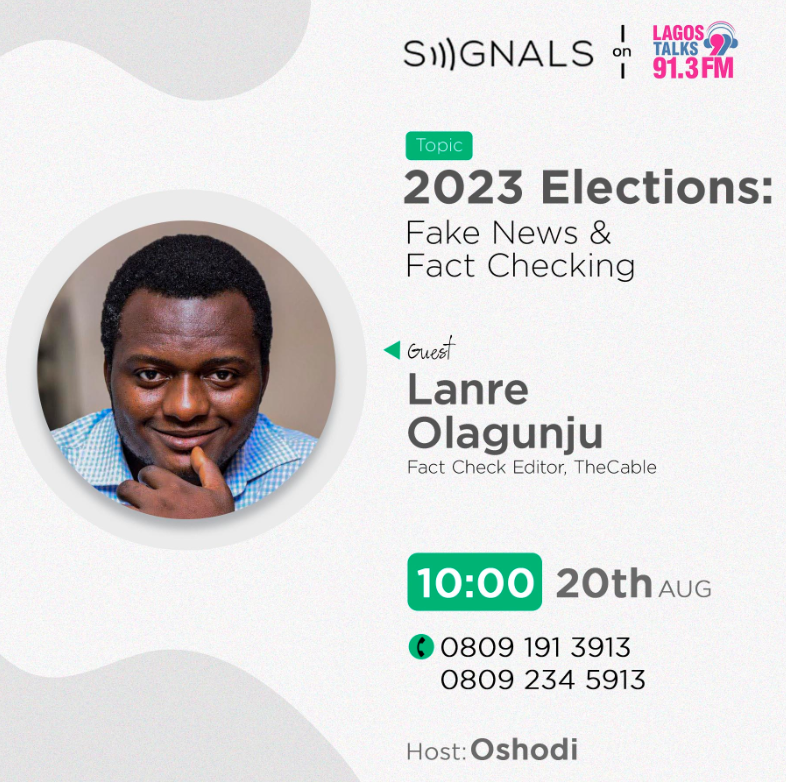
Lanre Olagunju, the fact-check editor with The Cable was our guest on Signals 99.3FM and he had conversations with our host Adewunmi Oshodi – Tapa on fake news and fact-checking ahead of the 2023 elections.
File image
Many people think fake news just started, it has been existing as long as we cant think about sharing information. Fake news comes as misinformation, disinformation and mal-information and they all have different consequences.
Olagunju said Misinformation is information that has no intention to mislead you. Disinformation is a deliberate decision based on falsehood while Mal-information is uttering statements such as libellous things against people or organisations.
A lot of Facebook accounts are built with fake news to gather more followers and they begin to sell to political parties to gain engagement and have a large audience. Some people also do this for popularity and anger towards the government.
The responsibility starts when individuals start to question Public holders about their promises, holding them accountable to their words. Individuals should be very curious and as well check campaign promises.
Journalism as a profession has to be objective, fair and balanced. The journalist must ask questions to ensure the quality of our conversations and focus on important issues. Ask questions about the statistical data given by politicians before reporting it out there.
He said Fake news started with the government citing an example of the 1989 broadcast of Nnamdi Azikiwe’s death by NTA while he was still alive. Another example was a Governor who came on air to say Nigeria spent trillions of naira on face masks and sanitizers that would have been used to settle ASUU, but did the country really spend trillions on those items?
Agreeing with him, one of our callers, Dennis from Apapa claims the FG is the purveyor of fake news.
Social media on display with fake news and hoax information. Searching on tablet, pad, phone or smartphone screen in hand.
Olagunju recommended education as the solution to the spread of fake news, elections are often between the devil and the deep blue sea, Jobs won’t reduce fake news, education will. If you can’t take your bias out of the line, your education will become irrelevant.
John from Bariga who also called in said dis-information and mal-information are as old as man. On his part, he cross checks his preferred presidential candidate over information they share. He also called for the education of people to be careful what they share.
We have to get every citizen involved at grassroots levels, we have to communicate in diverse languages and this must be spread to everyone.
Fake news may still come from people who mean no good but on our part, we have to check the credibility of the medium through which the news is shared, check if it is published by other mediums, read context of information to understand the intent and meaning, do not share if you are not sure of the source.
There is a need to be careful so as not to fuel up issues through fake news so as to avoid violence, mistakes and selfish interests during the election. He also sighted an example of what happened to Rwanda.




There are no comments